

Wednesday, May 6, 2015

Friday, April 10, 2015
Tsai Ming-Liang

Tsai at the Louvre, on the set of Visage

Goodbye Dragon Inn

I Don't Want to Sleep Alone

Stray Dogs

The River

Vive L'Amour

What Time Is It There?
Thursday, May 22, 2014
Cannes 2014
Based on what I've read so far, these are some of the films I'm most looking forward to seeing when they surface in New York, most likely at the New York Film Festival.


Adieu au Langage (Jean-Luc Godard)
Mr. Turner (Mike Leigh)
Jauja (Lisandro Alonso)
National Gallery (Frederick Wiseman)
Others include Timbuktu (Abderrahmane Sissako), Girlhood (Celine Sciamma), Saint Laurent (Bertrand Bonello), Leviathan (Andrey Zvyagintsev), Mommy (Xavier Dolan), Clouds of Sils Maria (Olivier Assayas), Foxcatcher (Bennett Miller), and Maps to the Stars (David Cronenberg). The Palme d'Or and other awards will be announced Sunday.
Thursday, May 15, 2014
Mizoguchi
I want to belatedly post a tribute to the great Kenji Mizoguchi, on the eve of his birthday and on the occasion of the essential ongoing series at the Museum of the Moving Image featuring virtually all of Mizoguchi's surviving films, the first such large-scale retrospective in New York since 1981. I remember attending the 1981 series at Japan Society and MoMA just a year after I moved to New York. That was the last time I saw many of the rare films in this series, and seeing them again 33 years later, in the context of re-viewing the more canonical Mizoguchi films (Ugetsu, Sansho, Oharu) which I have seen many times, is a revelation. In particular, I appreciate the importance of the great actress Kinuyo Tanaka to so many of his later films. David Bordwell's lecture and slideshow during the series' opening weekend also helped heighten my awareness of the master's visual strategies. My thanks to David Schwartz and Aliza Ma for organizing this magnificent retrospective, which will continue on to the Harvard Film Archive and Pacific Film Archive.

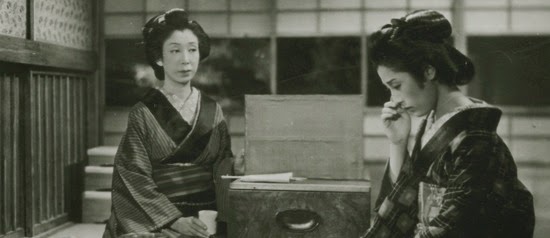


Sansho the Bailiff
The Story of the Last Chrysanthemums
The Life of Oharu
Ugetsu Monogatari
My Love Has Been Burning
Tales of the Taira Clan
Thursday, February 6, 2014
Highlights of Recent Online Criticism
Here are a few of the best recent examples of film criticism I've read which are available online.
First, Michael Koresky's The Long Day Closes: In His Own Good Time discusses one of my all-time favorite films ever since seeing it in 1993 at the San Francisco Film Festival, followed by a Q&A with Terence Davies. Koresky, in his piece for the Criterion Collection, captures what makes this uniquely magical and moving film so endlessly fascinating. The photo below is from the amazing Tammy sequence near the end of the film.

Adrian Martin's Dust of Time: Tabu, for Fandor, looks at the strategies by which Miguel Gomes subtly critiques the legacy of Portuguese colonialism and how the film's low budget led to its marvelous second half becoming a silent film within the film.

And Dream Lovers: Alain Guiraudie by Jonathan Romney in the current Film Comment nicely summarizes Guiraudie's career in conjunction with the recent retrospective of his films and the release of his latest, Stranger by the Lake. Below is a still from Guiraudie's casually homoerotic breakthrough film That Old Dream That Moves.

First, Michael Koresky's The Long Day Closes: In His Own Good Time discusses one of my all-time favorite films ever since seeing it in 1993 at the San Francisco Film Festival, followed by a Q&A with Terence Davies. Koresky, in his piece for the Criterion Collection, captures what makes this uniquely magical and moving film so endlessly fascinating. The photo below is from the amazing Tammy sequence near the end of the film.
Adrian Martin's Dust of Time: Tabu, for Fandor, looks at the strategies by which Miguel Gomes subtly critiques the legacy of Portuguese colonialism and how the film's low budget led to its marvelous second half becoming a silent film within the film.
And Dream Lovers: Alain Guiraudie by Jonathan Romney in the current Film Comment nicely summarizes Guiraudie's career in conjunction with the recent retrospective of his films and the release of his latest, Stranger by the Lake. Below is a still from Guiraudie's casually homoerotic breakthrough film That Old Dream That Moves.
Friday, January 3, 2014
Best Films of 2013
Following is my list of the best new films seen for the first time in 2013. Some of the best films released in 2013 are films I first saw at the New York Film Festival in 2012 (Abbas Kiarostami's Like Someone in Love, Raul Ruiz's Night Across the Street and Noah Baumbach's Frances Ha). Although I saw them again in 2013 when they had theatrical releases, I am not including them on this list. Also, I have not yet seen a couple of 2013 releases that might have made the list (Ralph Fiennes's The Invisible Woman, Martin Scorsese's The Wolf of Wall Street and Hayao Miyazaki's The Wind Rises).
Here are my favorites in roughly preferential order (I am updating frequently as I remember earlier omissions):


 9. Student (Darezhan Omirbaev)
10. Before Midnight (Richard Linklater)


 u
u


Here are my favorites in roughly preferential order (I am updating frequently as I remember earlier omissions):
1. Stray Dogs (Tsai Ming-Liang)

2. A Touch of Sin (Jia Zhang-ke)
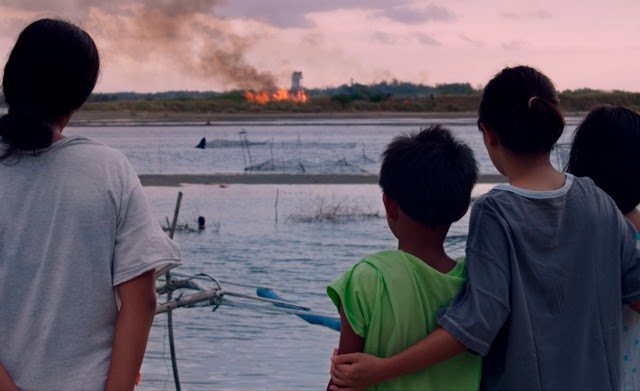
3. Norte (The End of History) (Lav Diaz)
4. Stranger by the Lake (Alain Guiraudie)

5. Museum Hours (Jem Cohen)

6. Drug War (Johnnie To)
7. Bastards (Claire Denis)
8. Computer Chess (Andrew Bujalski)
10. Before Midnight (Richard Linklater)

11. Gebo and the Shadow (Manoel de Oliveira)
12. Post Tenebras Lux (Carlos Reygadas)
14. At Berkeley (Frederick Wiseman)

15. What Now? Remind Me (Joaquim Pinto)
17. Paradise: Hope (Ulrich Seidl)
18. Spring Breakers (Harmony Korine)
19. The Grandmaster (Wong Kar-Wai)
20. Jealousy (Philippe Garrel)
Runners-up: Manakamana (Stephanie Spray and Pacho Velez, Nebraska (Alexander Payne), Inside Llewyn Davis (Joel and Ethan Coen), Her (Spike Jonze), The Unspeakable Act (Dan Sallitt), Blue Jasmine (Woody Allen), Only Lovers Left Alive (Jim Jarmusch), Nobody's Daughter Haewon (Hong Sang-Soo), Ilo Ilo (Anthony Chen), Stories We Tell (Sarah Polley), The Act of Killing (Joshua Oppenheimer), Enough Said (Nicole Holofcener), The Bling Ring (Sofia Coppola), This Is Martin Bonner (Chad Hartigan), Laurence Anyways (Xavier Dolan), and Blue Is the Warmest Color (Abdellatif Kechiche).
Two outstanding shorts from the New York Film Festival:
Redemption (Miguel Gomes)
The King's Body (João Pedro Rodrigues)
Two great made-for-TV movies or miniseries:
Behind the Candelabra (Steven Soderbergh)
Top of the Lake (Jane Campion)
And some of the best revival films seen in 2013:
 u
u
Mauvais Sang (Leos Carax)
Manila in the Claws of Light (Lino Brocka)

Batang West Side (Lav Diaz)
Many outstanding Chinese documentaries or semi-documentaries at MoMA, including:
Tie Xi Qu: West of the Tracks (Wang Bing), Oxhide II (Liu Jiayin), Old Dog (Pima Tseden),
24 City (Jia Zhangke), and Disorder (Huang Weikai)
Chimes at Midnight (Orson Welles at Anthology Film Archives)
Sylvia Scarlett, A Life of Her Own and The Actress (George Cukor at Walter Reade Theater)
Slightly Scarlet, Rendezvous with Annie and While Paris Sleeps (Allan Dwan at MoMA)
Germany Year Ninety Nine Zero, France/Tour/Detour/Deux/Enfants, various Godard trailers and
shorts (Jean-Luc Godard: The Spirit of the Forms at Film Society of Lincoln Center)
Donkey Skin (Jacques Demy at Film Forum)
Far from Vietnam (Alain Resnais, Jean-Luc Godard, William Klein et al.) (MoMA)
All I Desire (Douglas Sirk) and Forty Guns (Sam Fuller) (Barbara Stanwyck at Film Forum)
Tokyo Twilight and A Hen in the Wind (Yasujiro Ozu at Film Forum)
Equinox Flower (Ozu and His Afterlives at Walter Reade Theater)
Nostalghia (Andrei Tarkovsky at BAM)
Solaris (Andrei Tarkovsky at Film Forum)
Chocolat and Trouble Every Day (Claire Denis at MOMI)
The State I'm In (Christian Petzold) and Longing (Valeska Grisebach) (Berlin School at MoMA)
Sans Lendemain (Max Ophuls) and Only Yesterday (John M. Stahl) (Views from the Avant-Garde)
The Lusty Men (Nicholas Ray) (NYFF Retrospectives)
2013 was a great year for films new and old, and 2014 (with new films from Wes Anderson, Apichatpong Weerasethakul, Lisandro Alonso, Alain Resnais, Manoel de Oliveira and many others expected) should be as well.
Film Forum will have complete Hitchcock and Truffaut retrospectives beginning in February, and the Film Society of Lincoln Center has the films of Alain Guiraudie at the end of January. The Museum of the Moving Image begins its third edition of First Look on January 10. Film Comment Selects promises a rare Raul Ruiz, and that festival is followed by Rendez-vous with French Cinema and New Directors/New Films, as the annual New York cinephile cycle begins anew. I can't wait.
Tuesday, October 8, 2013
Bergman's Dreams
I am sharing this beautiful video essay on the theme of dreams in the films of Ingmar Bergman, recently posted at Criterion's website by Michael Koresky and Casey Moore.
Subscribe to:
Posts (Atom)