Friday, June 1, 2012

Cannes 2012

Amour (Michael Haneke)

Mekong Hotel (Apichatpong Weerasethakul)

La Noche de Enfrente (Raul Ruiz)

Holy Motors (Leos Carax)

Like Someone In Love (Abbas Kiarostami)

Moonrise Kingdom (Wes Anderson) and official Cannes poster

 In Another Country (Hong Sang-Soo)

Vous N'Avez Encore Rien Vu (Alain Resnais)

Post Tenebras Lux (Carlos Reygadas)
Although the official critical consensus has been that this was a very disappointing year for Cannes, there are a number of films (both in and out of Competition) that I am quite looking forward to seeing. Members of the New York Film Festival Selection Committee are on record as not liking the new Hong Sang-Soo film, so I don't expect to see that in the 50th edition of the festival. The others above (apart from the superb and already released Moonrise Kingdom) stand a good chance of making the final cut.

Friday, May 11, 2012

Migrating Forms


The annual Migrating Forms festival begins this weekend at Anthology Film Archives, and four films are of particular interest to me. Fritz Lang's The Tiger of Eschnapur (top) and The Indian Tomb, a diptych often referred to collectively as the Indian epic, screens Sunday night. On Tuesday Raul Ruiz's beautiful puzzle of a film, On Top of the Whale, will be followed by a tribute featuring readings and screenings of short Ruiz films.

There are also two selections from the vital and rarely-screened (in New York) Filipino New Wave. First, Khavn de la Cruz's Mondomanila on Friday, and then Lav Diaz's 6-hour A Century of Birthing (bottom), next Saturday.

Friday, April 20, 2012

Le retour de Bresson


The return of the traveling Robert Bresson retrospective to New York is most welcome. The touring series, which began at Film Forum in January and played several other cities (including Chicago, where my cinephile friend Dan caught The Devil, Probably at my urging), is now comfortably ensconced at the less crowded BAM Cinematek in Brooklyn. At last night's screening of Mouchette I was particularly focused on Bresson's extraordinary sound design. The climactic suicide scene gains much of its tragic power from the alternation of the sound of nearby gunshots with an eerie church bell that periodically rings in the distance.

After the film I bought James Quandt's revised, 700-page edition of Robert Bresson at the concession stand, trying not to get greasy popcorn butter on the cover. The first piece I read in the book is a wonderful photo-essay by Mark Rappaport which discusses the homoeroticism of Pickpocket and compares it to other films of the period like The Wrong Man and The Killing. Will I get sick of reading about Bresson after 700 pages? I think he is one filmmaker whose work remains inexhaustible.

Wednesday, April 4, 2012

New Directors/New Films

 Las Acacias

Neighboring Sounds


Porfirio


I saw only three films at this year's edition of New Directors/New Films, all from Latin America. Pablo Giorgelli's Las Acacias, from Argentina, Kleber Mendonça Filho's Neighboring Sounds, from Brazil, and Alejandro Landes's Porfirio, from Colombia, each reveal a high degree of formal and narrative assurance for beginning filmmakers. Las Acacias and Porfirio are moving examples of what J. Hoberman calls "situation documentary," blending a loosely-structured narrative with elements of documentary, somewhat in the manner of Lisandro Alonso (particularly evident in the opening woodcutting sequence of Las Acacias).

Neighboring Sounds is notable for its superb sound mix, its dark sense of humor and the escalating tension of its interconnected dramas about sex, petty crime, violence and class relations in the city of Recife. It marks the arrival of a major new director.

Thursday, March 15, 2012

The Deep Blue Sea


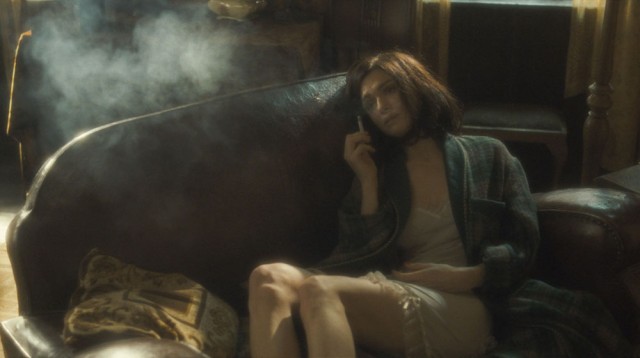
Terence Davies's new film, The Deep Blue Sea, based on a play by Terence Rattigan, receives a special preview screening tonight at BAM, followed by a Q&A with Davies and star Rachel Weisz. It is his first narrative feature since The House of Mirth in 2000. This is my most eagerly anticipated film of the year so far, since I consider Davies the greatest working British director and one of the greatest, period. The Long Day Closes, his masterpiece from 1992, which will have a week-long revival soon at Film Forum, is on my list of the 10 best films of all time. Davies uses a very precise, hypnotic visual and musical style to pull the viewer into impressionistic narratives of remembrance and loss. He is the Antonioni of British repression and bittersweet memory.

UPDATE 4/3:  One of the best pieces I've read about Terence Davies is by Michael Sicinski in Cinema Scope online. It describes the remarkable contradictions between Davies's radical formalism and his very conservative political worldview, which is complicated by class loyalty, his ambivalence about his homosexuality, and his identification with transgressive female protagonists. He says, "Davies is quite obviously an artist at odds with both his times and with what it means to be part of a marginalized group, systematically excluded from absolute belonging with the dominant culture. It is this anxious dislocation, I believe, that makes his films so deeply humane, and The Deep Blue Sea is no exception."

I will be considering Sicinski's ideas when I see The Long Day Closes, my favorite Davies film, again tonight at Film Forum.

Tuesday, February 14, 2012

2011 Top 20


Here is my official Top 20 film list of 2011 as submitted to Film Comment's annual Readers' Poll. I cheated with my number one choice by selecting a film I had already seen twice before, because I consider it the best film to premiere theatrically in New York last year, as well as representing my choice for best retrospective series of 2011, Edward Yang at the Walter Reade Theater. My runner-up retrospective would be Japanese Divas at Film Forum, which gave me a chance to see several great Mikio Naruse films again (including his masterpiece, Yearning). I also cheated with Skolimowski's Essential Killing, which I saw in January 2012 on Netflix streaming but which first played New York in 2011.

All the other films below I saw for the first time in 2011:

1. A Brighter Summer Day (Edward Yang)
2. The Turin Horse (Bela Tarr)
3. Once Upon a Time in Anatolia (Nuri Bilge Ceylan)
4. The Kid With a Bike (Jean-Pierre and Luc Dardenne)
5. The Tree of Life (Terence Malick)
6. A Dangerous Method (David Cronenberg)
7. Le Havre (Aki Kaurismaki)
8. Hugo (Martin Scorsese)
9. House of Pleasures (Bertrand Bonello)
10. Weekend (Andrew Haigh)
11. A Separation (Asgar Farhadi)
12. This Is Not a Film (Jafar Panahi and Mojtaba Mirtahmasb)
13. Dreileben (Christian Petzold, Dominik Graf and Christoph Hochhausler)
14. The Day He Arrives (Hong Sang-Soo)
15. Terri (Azazel Jacobs)
16. Pina (Wim Wenders)
17. Essential Killing (Jerzy Skolimowski)
18. Young Adult (Jason Reitman)
19. Margaret (Kenneth Lonergan)
20. Tomboy (Celine Sciamma)

I also want to nominate the reopened Museum of the Moving Image in Astoria, Queens as the best New York movie venue of 2011.

Thursday, January 12, 2012

The Hands of Robert Bresson

 Une Femme Douce


 The Trial of Joan of Arc

Pickpocket


L'Argent


A Man Escaped
In trying to find something new to say about the films of Robert Bresson, I decided to focus on one particular aspect of his films, the constant recurrence of images of hands. Whether in isolated closeups, covering faces, picking pockets, crossed in submission and handcuffed (the final sublime shot of Les Anges du Péché is the first of several such images in Bresson's work), or grasping objects, the hands of Bresson's characters are used to represent powerful emotions that are not conveyed through conventional acting styles of vocal inflection and facial expression, which he basically abandoned after Les Dames du Bois de Boulogne (below).


An awareness of Bresson's complex editing of sounds and images is essential in trying to understand and appreciate his films. I'm still trying after nearly 40 years of watching them. One might say the devil is in the details, probablement.